If Germany and Denmark are on your study-abroad list, this is the post to bookmark. Both countries run government-backed, fully funded postgraduate scholarship programmes that are open to Nigerians right now — one through a single Danish university's admissions process, and the other through one of Germany's most respected political foundations.
Neither of these is a "lottery" scholarship with thousands of applicants chasing a handful of spots. Both are structured, transparent, and looking for exactly the kind of candidates Nigerians tend to be — academically driven, community-minded, and ready to make the most of an opportunity abroad.
The best time to start a scholarship application is the day you find out about it — not the week before the deadline.
1. The Danish Government Scholarship — University of Southern Denmark (SDU)
The University of Southern Denmark (SDU) is one of the country's leading universities, and it participates in the Danish Government's scholarship scheme for non-EU/EEA students. What makes this scholarship attractive is its simplicity: there is no separate scholarship application, no extra essay, and no additional portal. You apply for your Master's programme as normal, and if you're admitted and meet the criteria, you're automatically considered for the scholarship.
Denmark consistently ranks among the happiest and most liveable countries in the world, and its higher education system is known for being practical, research-driven, and English-friendly — most Master's programmes at SDU are taught entirely in English.
What the SDU Scholarship Covers
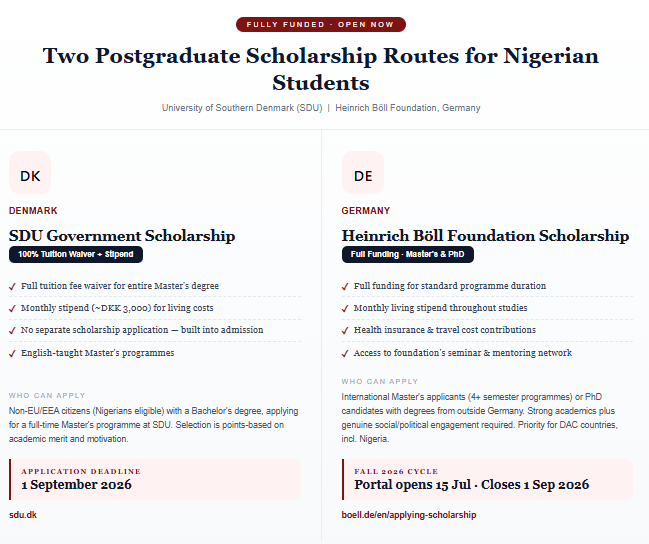
Tuition: A full tuition fee waiver for the entire duration of your Master's degree, typically two years.
Living costs: A monthly stipend of approximately DKK 3,000 to help with accommodation, food, and day-to-day expenses while you study in Denmark.
Together, this means that if you're awarded the scholarship, you complete your entire Master's degree without paying tuition, and with some monthly support toward your living costs — a significant relief compared to the full international student fees Denmark normally charges non-EU applicants.
Who Can Apply
To be considered for the SDU scholarship, you need to meet the following:
You must hold a Bachelor's degree from a recognised institution, or be on track to complete one before your programme starts. You must be a citizen of a country outside the EU, EEA, and Switzerland — Nigerian citizens fully qualify under this rule. You must be applying for a full-time English-taught Master's programme at SDU. You must meet the specific academic and language requirements of your chosen programme — most require IELTS or TOEFL, though some accept alternative proof of English proficiency if your previous degree was taught in English.
Selection is competitive and points-based. SDU reviews every applicant's academic record, motivation, and overall profile, and scholarships are awarded to the strongest candidates within each programme's available quota. Not every programme has the same number of scholarship slots, so it's worth checking the specific programme page on SDU's website to confirm scholarship availability before you commit to applying.
Step by Step — How to Apply to SDU
Browse SDU's English-Taught Master's Programmes
Visit the official SDU website and explore the full list of Master's programmes taught in English. Shortlist programmes that match your academic background and career goals, and confirm that they participate in the Danish Government Scholarship scheme.
Check Programme-Specific Requirements
Each Master's programme has its own academic prerequisites and language requirements. Review these carefully — some programmes may require specific Bachelor's degree backgrounds, minimum GPAs, or particular English test scores.
Prepare Your Documents
You'll need your Bachelor's degree certificate and transcripts, a CV, a motivation letter tailored to your chosen programme, proof of English proficiency, and a copy of your passport. A strong, well-written motivation letter matters here — since this same application doubles as your scholarship application, it's worth investing real time into it.
Submit Your Application Through SDU's Admissions Portal
Apply through SDU's official online admissions system before the deadline. For the February 2027 intake, the deadline is September 1, 2026. SDU also runs a September intake with an earlier deadline, so if you're aiming for that instead, check the official site for the exact date.
Wait for Admission and Scholarship Results
If you're admitted, you'll automatically be considered for the scholarship as part of the same evaluation. There's nothing further to submit — just wait for the outcome of your application.
2. The Heinrich Böll Foundation Scholarship — Germany
The Heinrich Böll Foundation is a German political foundation named after Nobel Prize-winning author Heinrich Böll, closely associated with Germany's Green political movement. Every year, it supports around 1,200 to 1,500 students — including a significant number of international scholars — through one of the country's most respected scholarship programmes.
What makes this scholarship different from most is that academics alone won't get you in. The foundation is explicitly looking for students who pair strong grades with a genuine commitment to causes like environmental sustainability, democracy, human rights, and social justice. If you've been active in volunteering, activism, student leadership, church or community organisations, or any form of civic engagement, this is exactly the kind of profile the foundation wants to see.
For Nigerian applicants specifically, funding comes through Germany's Federal Foreign Office, which supports international students from outside the EU — and the foundation gives priority to applicants from DAC (Development Assistance Committee) countries, a list that includes Nigeria.
What the Heinrich Böll Scholarship Covers
Full funding: Covers the entire standard duration of your Master's or PhD programme in Germany.
Monthly stipend: A regular living allowance paid throughout your studies to cover accommodation, food, and daily expenses.
Insurance and travel: Contributions toward health insurance and travel costs are included as part of the package.
Beyond the financial support, scholars also gain access to the foundation's network — seminars, workshops, and community events that bring together students who share similar values around social and political engagement. It's as much a community as it is a funding programme.
Who Can Apply
For Master's applicants: You must have already completed your first degree (Bachelor's) outside Germany, and be applying to start a Master's programme in Germany. Importantly, the foundation only funds Master's programmes with a standard duration of four semesters (two years) or more — one-year Master's programmes do not qualify.
For PhD applicants: You must have already completed your graduate (Master's) degree outside Germany, and be applying for or already admitted to a PhD programme in Germany.
For both levels, the foundation looks for a strong academic record throughout your education, demonstrated social, political, or community engagement (volunteering, activism, leadership roles, NGO work, and similar), and a clear, well-written motivation that connects your personal values to the foundation's core themes of ecology, democracy, and social justice. Proof of admission or enrollment at a German university is required by the interview stage, though you can begin your application before having a final admission letter in hand.
On language: while a German language requirement (around B2 level) is often mentioned, this mainly applies to programmes taught in German. If you're applying for an English-taught Master's or PhD, English proficiency is the priority — though having some German is generally viewed positively and may be required depending on your specific university and programme.
Step by Step — How to Apply to the Heinrich Böll Foundation
Secure or Plan Your University Admission
Identify a Master's programme (four semesters or longer) or a PhD programme at a state-recognised German university that matches your field. You don't necessarily need a final admission letter to start your scholarship application, but you'll need proof of admission or enrollment by the interview stage.
Reflect on Your Social and Political Engagement
Before you start writing anything, take time to think through your history of community involvement, volunteering, activism, or leadership. This is genuinely a core part of what the foundation is evaluating — not an afterthought — so give it the same attention you'd give your academic credentials.
Wait for the Portal to Open
The Heinrich Böll Foundation runs two application cycles per year — Spring (15 January to 1 March) and Fall (15 July to 1 September). For the Fall 2026 cycle, the application portal opens around 15 July 2026 and closes 1 September 2026. The portal only opens about six weeks before each deadline, so mark your calendar.
Prepare Your Documents
You'll need a CV, academic transcripts and degree certificates (with certified translations if needed), a motivation letter covering both your academic goals and your social/political engagement, an outline of your community involvement and political interests, and — for PhD applicants — a research proposal outline. Proof of university admission or enrollment is also required, though it can sometimes be submitted closer to the interview stage.
Submit and Prepare for an Interview
Register on the foundation's online portal once it opens, complete all sections, and upload your documents before the 1 September 2026 deadline. Shortlisted candidates are typically invited for an interview as part of the final selection process.
Important Links You Must Save Right Now
For the SDU Denmark scholarship, visit the official university website here: https://www.sdu.dk — browse English-taught Master's programmes and confirm scholarship eligibility on each programme page.
For the Heinrich Böll Foundation scholarship, visit the official application page here: https://www.boell.de/en/applying-scholarship — this page has the most up-to-date cycle dates and requirements.
Final Thoughts
These two scholarships represent two different philosophies. SDU's approach is simple and merit-based — get admitted, and the scholarship follows automatically. The Heinrich Böll Foundation asks for more — it wants to know who you are beyond your transcripts, and what you stand for. Together, they cover two of Europe's strongest study destinations, and both are realistic, well-established routes that Nigerians have used successfully before.
Start preparing your documents now. Deadlines that feel far away in June have a way of arriving faster than expected. 🌍
Join Our WhatsApp Group
Stay updated with quality scholarship opportunities, travel information, and study abroad guides every week.
Join WhatsApp GroupNeed Help Applying?
Not sure how to write your motivation letter, structure your application, or prepare for an interview? We help Nigerians navigate this process from start to finish. Reach out today and let us get you moving.